18/03/2018

Navroz mubarak

When is Nowruz 2018, what is Haft-Seen and how is the Persian New Year celebrated?


Nowruz, or Navroz, is celebrated by hundreds of thousands of people across the world on March 21, but just what does this special day signify?

ON March 21, hundreds of thousands of people across the world will be welcoming in the New Year and celebrating the first day of spring in a festival called “Nowruz” or “Navroz”.

Several countries mark this day as a national holiday. Here’s the lowdown on this exciting traditional celebration.


What is Nowruz?

Nowruz, or Navroz, is the Persian New Year and the traditional festival marking the beginning of spring.

The day is believed to promote peace, solidarity, reconciliation and neighbourliness, and is designed to be filled with good food, new clothes and quality time with loved ones.

The festival is observed in Middle Eastern, and Central and South Asian communities.

The traditions associated with it date back around 3,500 years ago.

Navroz was officially registered on the UNESCO List of the Intangible Cultural Heritage of Humanity in 2009 and is celebrated on March 21, the day of the equinox.


How do people prepare for Nowruz?

In the weeks leading up to the New Year, homes are thoroughly cleaned (much like a spring clean, in essence) and all broken items are repaired or replaced.

New clothes are worn and indulgent meals are prepared to be shared with loved ones and friends alike.

The day is spent by visiting friends and relatives, exchanging festive greetings, gifts and good wishes.


What is the Haft-Seen?

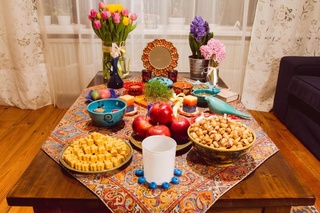
Haft-Seen is a table-top arrangement of seven symbolic items traditionally displayed to mark the New Year and the first day of spring.

The seven items all begin with the letter S - the primary items are:

Sabzeh – a wheat plant as a symbol of greenery, nature and exhilaration. Some say it symbolises wealth and love too.
Samanu – a sweet pudding made from wheat germ symbolising power and bravery
Senjed – dried Persian olives symbolising wisdom
Seer – garlic to symbolise stimulation and contentment
Seeb – an apple to symbolise health
Somāq– sumac berries to symbolise patience and tolerance
Serkeh – vinegar symbolises disinfection or cleanliness
The table will also include a coin, to represent wealth, a mirror to symbolise light, candles for children and family, and often a religious text.

16/03/2018

FOR CAUSING PREGNANCY

If a woman fails to carry pregnancy or miscarriage continues to take place, the following taweez (tilsim or zapis) be put round the neck or waist of the woman. The taweez should be written after muttering Fateha of Hazrat Ibrahim (alaihis-salam) over the sweetmeat.

12/03/2018

Tilsam For Love

The following  tilsam be written on Thursday  at the decaying hours and fastened with the right arm which would prove effective provided it is written in the beginning of a month.


18/01/2018

The practice of Bosnian healing

Diagnostical techniques


To diagnose diseases Bosnian healers (hećimi, hodže, derviši, stravarke) make use of various techniques.

The first rather obvious technique is an extensive conversation with the client and the people connectd with him socially. One of the healers interviewed said that it is essential to have an insight into the character of a client, because it supplies him with a lot of information about the causes of the client's illness.

The second technique is the use of texts and recitations from the Qoran, the hadith or some particular instruction manuals. A Bosnian healer said thar, after having spoken with a client about his afflictions, he starts to read from the Quran. As soon as the client starts yawning, laughing or crying there is an indication that a supernatural power is at stake. This healer said: „If the client starts crying I know that it is a matter of the Evil Eye (urok). But when he is convulsed with laughter he is possessed by an evil spirit or nagrajisao, ograjisao“. Other healers make use of certain instruction manuals. A Bosnian healer said that when someone consults him about headaches he asks for the names of the client and of certain of his relatives. Subsequently, he is able to look up the causes of the headaches in his manual. Sometimes the client must put his finger on such a book. The healer can then draw certain conclusions from that.

The third diagnostical technique is the so-called „cupping“ or hidžama. This technique is practised by a Bosnian healer. It consists of inflicting light bleedings. If, for example, someone feels a pain extending from his shoulders to his head, the healer heats a drinking-glass by burning some paper. Subsequently, he makes two little scratches on the shoulder of the client with a razor-blade and puts the glass over them. In the opinion of the healer it may be possible for black blood to flow from the injuries. In that case the pain will disappear immediately.

The fourth technique is a ritual with lead or salivanje strahe. A Bosnian healer (stravar or stravarka) uses this technique frequently. He writes a text on a piece of lead and gives that to the client. At home the client (bolesnik) has to melt the lead in a pan. After that he must wrap himself into a sheet and put a bucket of water between his legs. He then must throw the lead into the water so that it will harden. After the ritual the client must wash himself with the water. He must take the lead with him when he goes back to the healer. In the coagulated lead the healer will see indications of what power has caused the affliction and what part of the body has been affected.

The fifth technique is the conjuring up of spirits or sazivanje daire. To one of the Bosnian healers (derviši) this is the most important of the diagnostical techniques, as well as a therapeutical technique. He hypnotizes his clients and by means of them he conjures up spirits (džine). It some cases these spirits are djinns and in other cases they are the spirits of living persons. In the course of a hypnotizing-session the healer takes the spirit of the client or the medium to certain locations and situations and allows him or her to communicate with other spirits.  That way he discovers all the facts regarding certain problems or the causes of a particular illness. Then he punishes the guilty djinn or the spirit of, for example, a magician (sihirbaz) who has practised black magic.

source:
www.tana.bosnianforum.com

28/12/2017

Two Shawia Amulets

These amulets, meant to protect against occult forces such as jinns and the evil eye or natural dangers such as illnesses and poisonous animals, traditionally consist of writing in Arabic characters done with saffron-colored water or ink from burned wool on paper or animal skin. They are worn enclosed in a little leather bag or a silver locket.


Amulet against poison and poisonuos animals


Amulet to „unknot“ headaches and neuralgia


10/12/2017

In the world of the Jinn and Shaytan

Existence of the ghost or spiritual world always spurred great interest among people. How i t came to be and what kind of creatures inhabit it is somewhat explained in the holly books, however, more information is provided through folk tales in which numerous experiences by talented individuals have been accumulated, heightened sensibility by such individuals and their occult knowledge opened the doors of gaib for them – the invisible world and enabled communication and insight of ethereal forms which dwell in that second reality.

According to the mythological traditions of the Middle East during the time that almighty Allah created the first people he didn’t divide the world into material and spiritual, however, since people were deathly horrified when meeting Jinn beings, especially their children, the wise Allah decided to separate humans and Jinn by placing an invisible curtain between them, thus creating two worlds, or better to say two spheres, one of humans and the other of spirits. Since then humans and Jinn exist side by side without much issues, with one exception that they can see us clearly and we cannot see them.

In the world of gaib which literally is teeming with the numerous population of various spirits, Iblis is the king of all Jinn, and as such he causes great contradictions among theologians, especially regarding his origin. Certain scholars believe that in the beginning Iblis was an angel, others that he is the son of a Jinn which was taken into heaven to get an education, where he got the name Azazil. Egyptian philologists derivate the name Iblis from the root b-l-s which means “has nothing to expect”, since Iblis has nothing to expect from Allah’s mercy due to Iblis’ evil nature. We come across a belief that Iblis belongs to earth Jinn which is evidenced by his name Al-Hakam i.e. judge which he gained at the time when Allah sent him to judge his kind, when Iblis was a young Jinn only a thousand years old. In the second thousand years Iblis grew haughty and led a rebellion against god and his rule.

The most interesting thesis about Iblis relates to his sex i.e. suggests that he is a hermaphrodite which lives in a distant island in the middle of the sea where he lays three thousand eggs from which then come the Jinn. Iblis sends them to all parts of the world in order to spread and strengthen his dominion across earth.


Jinn as people

Some pre-Islamic polytheists claimed that the name Jinn signifies souls of planets which is why, accidentally or not, in Arabic occultism we come across seven planets and seven Jinn kings which are arranged according to their influence.

In the hierarchy of creation of Jinn the lowest class are Ifrit or Afarit. Allegedly, according to legends Ifrits can be created from humans which die suddenly or violently since out of such shocking trauma for the human soul and Ifrit is born. After them come the Maridi, Jinn which lives underground, and so forth in the long list of these supernatural beings.


When it comes to the appearance of these ethereal creatures we need to mention that there are numerous species or tribes of Jinn, where each is different from the other. But, despite this we can enumerate their common characteristics. The largest Jinn has a body 17 meters tall and the smallest 17 centimeters. While dwelling in their world the Jinn have a sort of veil over them but when they appear in the material world then they’re dressed in yellow since it is an equivalent of fire. Their presence in the human dimension is given away by an unpleasant smell made out of a mixture of sulfur and tar. Another interesting detail which can help identify Jinn is that they have four fingers, they don’t have a thumb – unique symbol of a human. Other specific features are their eyes which resemble those of reptiles, especially snakes, but once they materialize in front of people then they get red eye with a burning glow.


Jinn speak all earthly languages, even the old and forgotten ones, similarly they have their own language which they can teach to individuals they come into contact with and form an alliance. Their world is a copy of the human world i.e. they have their states, cities, rulers, families, they love or hate each other, kill each other, perform war, give birth etc. They have various religions which existed in the world, there are atheists, even cannibals. They’re present across the galaxy and inhabit various planets. They live for a very long time, a couple of thousand years and are temperamental and difficult since they stem from a flame of molten lava which shaped our planet millions of years ago.


Shaytan work

Unlike the Jinn, Shaytan in Bosnian tradition are described as small creatures green-yellow in color with a long tail. One eye is open while the other is closed, since he cannot see with that eye. Also, though they have two legs they’re actually lame. They literally drag the other leg. Because of these defects on the spiritual ladder their rank is the lowest, they’re cowards by nature, they can be chased away by a common curse. But, they shouldn’t be underestimated since they can be cunning. In Islamic tradition Shaytan is actually the one that leads people into sin and not the Jinn. Namely, when a Shaytan enters a human and possesses him, then the person will become pronouncedly prone to vices; gambling, infidelity, alcoholism, drugs, lying and treason. If a person is possessed by a Jinn the person then loses his mind, becomes a psychiatrist case, has hallucinations, has one part of the body paralyzed, suffers epilepsy or falls into delirium.

Since Shaytan are extremely frustrated due to their physical appearance and deformity, as well as the position he takes, he is obsessed daily with jealousy and hatred towards everything and everyone – this literally seeps from the healthy but spellbound eye. In our tradition it is claimed that Shaytan like to gather near springs and observe people, especially young girls and young men which come there to drink water, in order to spellbound them with their eye. Unlike the Jinn, Shaytan are extremely tied to humans and they like to be near them. We learn about this from the tales of our Bogomil forefathers which recounted that the Shaytan purposefully made holes in the earthen human body and in a wicked way managed to climb the resurrected human’s left shoulder and stay there forever, becoming a part of his nature and character.

In cunning, skillful  deceits and limitless persistence lies the Shaytan’s strength and power. At the same time this demonstrates the thesis that we’re talking about a pretty intelligent being which knows studiously human nature and weaknesses. Besides the shoulder Shaytan have other favorite places in which they dwell and among them is the landmark or border over which people quarrel and hate each other about since the old days. Actually, wherever there is a fight or bad blood, folk wisdom will say, the Shaytan will dwell.

Also, in each house there is the same number of Shaytan as the number of household inhabitants, however the number of Shaytan can be increased using a tabooed activity, for example if you sharpen one knife against another knife. Therefore each time one sharpens a knife it should be passed through fire and the prayer Euzubilah should be uttered. In this way they’re chased away.


Prophecy about a female Shaytan


It is interesting to note that in Persian-Arabic magic there is no ritual of invoking the Shaytan but only the Jinn. We can conclude thus that they’re untamable and stubborn creatures whose primary mission from the day they were created, to create unrest and doubt into the hearts of humans and to cause them to behave badly. Shaytan are thus true enemies of religion and exemplary life. Because of the pronounced influence into human history and everyday life we shouldn’t wonder why people paid them more attention than the Jinn, which resulted in them becoming parts of numerous folklore tales and prophecies.

Old Bosnian grandfathers and grandmothers still today talk about the things they remembered from their forefathers’ traditions which spoke about our world being ruled over by a male Shaytan, which according to the old folk was better since he was a male. But, with the coming of the new millennium the ruler has changed and humans entered a catastrophic age.

-“When a female Shaytan rules of the earth – the old people would warn us – “hard times will arrive, our people (Bosnian) will scatter across the world, we will desire to see each other. While the female Shaytan rules over the world a great stone will fall from the sky and destroy Mecca and Medina. After that more people will attend a funeral in Bosnia than there will be living in Mecca and Medina. That will be the punishment from the lord for those that defiled and desecrated the purest religion with their greed and infidelity.

In the rest of the prophecy old people said the following: “Woman and animal will have more rights than any male, all values will disappear and other grotesque rules will be enforced in order to degrade the human kind to that primitive animal level…” As we can infer from the rest of the prophecy about the female Shaytan it is evident that a nuclear war will take place on earth which will lead to the complete destruction of our civilization but the human population will decrease drastically, those that survive will mutate due to the radiation and will give birth to small children with only one eye, which in itself resembles the Shaytan. Life will continue below the earth since on the surface no condition for living will remain.

03/12/2017

Nafaka (provisions) kept us going

Bosniacs people are the only one in the Balkans that use the word nafaka on an everyday basis. In accordance to this it is worth analyzing culturally and linguistically this word, because of its immeasurable role in studying the traditional life of our people. At the very beginning of this short study it is necessary to note one irrefutable fact which states that the Bosniacs people in its long history were exposed to numerous misfortunes, even a real danger of extinction, but what has kept and saved them is their cheerful spirit and incorrigible optimism often summed up in this short phrase: “God will give us nafaka!”.  

Nafaka is an Arabic word which reached us through the Ottomans. It is very important in Islamic teaching since it manifests Allah’s mercy and in the Turkish language it has numerous synonyms. In Bosnian nafaka is translated in a few ways: alimentation, provisions, supply or supply for life. Two more terms in everyday use which signify wellbeing and success are the Persian word baht – luck, we come across it in certain love spells, and the Arabic word bereket (berićet) – progress, prosperity. Besides these others, especially in folk speech, in use are words of  similar meaning such as hair, rizk, rahatluk, etc. All of these represent fertile and positive events which present themselves as feelings of content, ecstasy and optimism. Psychological effect is manifested in the weight of the word nafaka, which compares her to the state of hoe, solace or hidden happiness. All of this is evident in statements such as: “You never know where your nafaka is waiting for you!”, “New day – new nafaka!”, etc. This is why people believe in nafaka fatalistically (“No one can take away your nafaka!”), like almost everything else that is tied to the holly and divine.

Definition of the term nafaka is a relatively wide and according to some dictionaries could be shortly describes by the following: “what is determined for a human to eat in this world”. When a diseased lives long, it is said: “he collected (or bought) his nafaka” – when someone before they die eats a lot he desires to eat what is his in this world.


According to my opinion nafaka is a term which in everyday discussions takes the place of the term luck but also human destiny i.e. life. Perhaps it would be explained simply that nafaka signifies everything that a person is destined to receive and live through as ordained by God. Among the folk we can often hear “every child carries (brings forth) their nafaka”, which was used by poor parents to protect themselves from the criticism of their surrounding because they’re poor enough even without children.


Nafaka determined by God

Identification of human birth, living and death is summed up in the collective consciousness of Bosniacs people in the term of nafaka; “He was born with such nafaka!”, “Whosever is born with good nafaka no one can harm him!", “Such is his nafaka!”, “He ran out of nafaka and died”. “Nafaka is the best hero!” – according to the belief in destiny, if someone is destined to live, i.e. he didn’t run out of nafaka, he can avoid death and become a hero. According to folk tales a man lives so long as God has prescribed nafaka to him, not a minute longer. On that day when a man uses up his nafaka he will die. According to the above we can conclude that folk wisdom doesn’t know happy and unhappy people, but classifies them exclusively with greater or lesser nafaka.

Belief in nafaka is a perfect example how long certain beliefs were deeply incorporated in the traditional lives and that they create a certain notion of an individual towards society, but also himself. Primeval desire and need of every human being is to a large extent determined by the percentage of luck in their life, since as folklore deliberation suggests, a happy man is healthy, successful and cheerful. That’s why everyone of us intimately identifies with the term nafaka. However, from the tales of older people we could easily conclude that the perception of nafaka is individual and primarily depends on the percentage of modesty, i.e. how much an individual is content.

Origin of nafaka coincides with the folk belief about human fate. Still to this day it is believed that Allah determines the destiny of every embryo in its first 40 days, which is why an ugly person marries a beautiful woman, a stupid man becomes rich, etc. Certainly, there are opposite examples but all of them are a product of smaller or greater nafaka which a person carries inside of them. I remember the discussion with the late Bilka, stravarka from Stijena (Cazin), almost a decade ago, which used to talk about herself and her work and often said that she always had nafaka, as if it came out of the earth or fell from the heaven, she used to say. Based on the above we could conclude that nafaka is weaved into the human beings, but that it also exists in everything around us due to its divine source.

To some extent nafaka can be called god’s justice. –“No one can take away your nafaka!”, older people would say when they wanted to explain fatalism, the thing which was destined to someone. For example, it happened that a father desired to leave his inheritance to the youngest child, despite the opposition of other family members. No matter the various blackmails and games that the family played in order to change the fathers mind, the house in the end was left to the youngest child.

Also, without halal (permissible) there is no nafaka. Namely, there will be no nafaka in the thing given as gift unless it is given from the heart – halal. That’s why stolen or forcefully taken things are unlucky since they don’t have god’s mercy in them.

Nafaka is a word which creates pleasure and happiness and ubiquitous way favours human senses. It caresses his eyes and ears, seduces the nose and overwhelms with pleasure the palate. If a sudden guest arrives during coffee or lunch, people would tell him: “You came with nafaka, come on in!” or "Welcome, it is your nafaka to eat (drink) this with us!”. However, terminology in this case cannot be simple in this case nor can it be summed up in such an obscure form. Namely, in folk discussions for meal the term often used, even today in rural areas, was "nimet", primarily for bread or cake, but generally for food also. Therefore it is wrong to equate the term nafaka with food, instead it should be viewed through a wider prism, in which we can hint numerous meaning of everything which this Arabic word represents.


Summoning nafaka

Generally, though considered to be divine gift of mercy, i.e. something that mortals have no effect on, strong desire for it among the people gave birth to various ritual actions that summon nafaka. Desire for nobility dominates in them since a generous act attracts good which is what the saying from Kladuša confirms: “Give alms, continue nafaka!”. Similarly, grandmothers and grandfathers which bless the young would often say: “May Allah give you gani nafaku!” or “May god give you unimaginable nafaka!”, people claim that it is better than “the seen one” since it s greater and more plentiful.

In Cazin and Velika Kladuša the prevailing belief was that nafaka could be summoned, namely, when one would buy cattle or something else it was a custom to buy it in the name of the family member for which it was believed to have the most nafaka, in order to allude that with such a purchase the thing would be nafakali i.e. advanced and happy. Similarly, when buying a stove the first fire will be lit by the family member which was thought of as having the most nafaka in life, in order for the home and family to be prosperous and protected against evil.

In this part of Bosnia a ritual with trahana (tarahana – Persian stew) was known which was used to summon i.e. stimulate nafaka. If someone is unhappy, business isn’t doing well or is prone to bad luck, during young Friday he would make trahana but in such a matter to let it overflow on fire (stove). While the boiling white water is overflowing from the vessel the person would repeat three times:

Bismilahir rahmanir rahim.
As this tarhana is overflowing
on all sides,
so too may my nafaka overflow and cover me,
with god’s will an my prayer.

Bosnian:

Bismilahir rahmanir rahim.
Kako ova trahana izvirala i kipila
na sve strane,
tako moja nafaka izvirila i mene obasipala,
sa božijim emerom a mojim sepom.

After cooking tarhana in this manner and cooling it, it would be consumed for three days. Some informants recommend eating the stew in small batches for seven days. In such a manner, it was believed, nafaka would be summoned.

In this context we shouldn’t forget to mention halva – sweet that takes an honourable place among Bosnian people. It is traditionally made (roasted) on the eve of Ramadan, Laylat al-Qadr and Eid, since its smell cleanses the entire house and attracts nafaka and wellbeing.


To be of a lucky hand

Tying food and nafaka is not rare in folklore of our people and is especially evident in marital customs, part where the bride arrives before the grooms house, where she is showered in candy and money. At the threshold of the house she is welcomed by a poor woman, she takes her shoes off, and the bride gives her a gift. A little later she is welcomed by the mother-in-law with the Qur’an and cake with two jugs of water in hand. She places the cake under her left and Qur’an under her right armpit, two jugs each in one hand. Bride reaches the hearth, Qur’an is given to the women, cake and water is placed on the hearth. It is believed, that the bride brings nafaka into the house with this ritual gesture. Also, it was a custom for the bride and the groom to “break” the cakes, and if for example a larger piece of the cake stays in the grooms hand it was believed that he will have greater nafaka, and vice versa.

In Velika Kladuš in the past there was a custom of  a bride spreading her handkerchief on the threshold of the house and kissing it, before entering the grooms house. She enters the house with her right foot and someone takes off her shoes, since some money would be hidden in her shoes as a gift for the person that takes off her shoes, she then goes towards the hearth. She kneels there, she divides the embers using tongs, throws her handkerchief into the fire to burn – for nafaka.

For certain jobs it is very important to be gifted with nafaka. Namely, for a stravarka widely known for successful lead melting or for an Imam which writes effective talismans and amulets, people say that they have “nafakali (lucky) hand”. While melting lead, there are a lot of small pieces at the bottom of the vessel, the stravarka will comment: “it is nafakali!”, i.e. the diseased will get better.

Before starting the divination process the diviner asks for the money from the client in order to encircle the cards or beads three times around it and place the money in her pocket, explaining that the process if used for nafaka. Similarly, if nine groups of four beads appear during the divination process, so called hadžirli hatma, the diviner will utter contently: “Your beads have fallen on a great nafaka, cover it with a red cloth!”.

In the end we should mention the following belief according to which it is not good to give names to children of deceased family members since “whoever died he has no nafaka left”.  

Autor: Raif Esmerović

22/11/2017

Circle of destiny: Universal Mother and Sep

Bosnian horoscope or circle of destiny is based in its essence on principles of folklore (agricultural) calendar which divides the years into two seasons – summer and winter or better to say, to the light and dark part. (1) Inside such a division there are twelve signs from which half belong to the light and the second to the dark part of the year, and as such they are each other’s opposites. Circle of destiny is a graphical representation of Universal Mother’ stomach, symbolic characters which are depicted in that divine circle represent all living world which exists on earth and they are plants and trees, animals and humans. In a direct and picturesque way this is a representation which shows that we all come from the same source and that we are connected and that we cannot exist without each other. Shortly, Bosnian horoscope is a shamanistic representation of what our forefathers (Illyrians) believed in, with a clear focus on nature and its forces in their ongoing interaction they create a unique symbiosis of material and spiritual strength.

Patronage i.e. the most influential elements on the circle of destiny are Sun, Moon and Earth as well as four elements, everything that we have been throughout history and all our lives exposed to. Although four elements are in constant permeation, as keepers of life and harmony, they have their considerably stronger influence in certain parts of the year so that in the warmer part of the year the elements of wind and fire dominate, while in the cold part water and earth dominate. Through the influence of elements we can follow the base of the circle of destiny and cycle of life and death, which in its alternation encourages life energy and creates fertility.

It is known that Illyrians have inherited matriarchy in whose centre was the worship of Universal Mother – “One which gives life to everything”, whose existence we can find in oral traditions of our people, from which we would point out the ones about the separation of the year, tales of snijet and other certain mythological representations. 
Though at first sight they may seem as parts of different traditions all of them are segments of a unique cult of fertility, which has remained in the collective consciousness to this day due to its existential purpose.

Celebration of fertility and love

Beginning of the dark part of the circle is called “feasting” or “feast” since it represents a period of year when the fruits are ripe i.e. fertility has reached its peak. Since the old days it was an opportunity to stage festivities of thanks and celebration since then the community has ample food to live off of until spring. That’s why Universal Mother is celebrated, a personification of all deities of fertility in various cultures, alfa and omega of entire creation. But, though this event represents the end of the light part of the year and entry into a dark one, we shouldn’t forget that it doesn’t signify anything bad nor negative but quite the opposite. It, namely, hints at the pagan new year which at this time of plenty has ideal predispositions for celebration and happiness.


Before the beginning of the dark part of the year since the old days people ploughed their fields in order to sow wheat, symbol of Universal Mother, i.e. in a ritual way stimulate from the beginning the cycle of fertility. By no accident, in the autumn among Bosnian people traditionally marriages took place, since agricultural works were finished, food was plenty and with that conditions for humans to “plant” their seeds was met and to renew life in the community. That’s why since the old days this was a period of giving thanks but also love. All of this was favoured by elements water and earth, both symbols of female fertility, which in the Universal Mother herself indicate creation of a new life. Namely, in monotheism it is claimed that a human being is created out of earth, and in the much older traditions life is created from earth.

Holly silence

In the second part of the dark part of the year which is called “holly silence” nature is in the phase of apparent sleep i.e. hibernation, forces of life receded deep into the ground and are awaiting after three full months, when fire and air assume domination, to awaken and activate. But, while “holly silence” lasts a real mythological play is taking place in which unstoppable desire for existence through a new birth culminates with death. Namely, at the time of hibernation (sleep), complete calmness of nature in winter months, sleeping Universal Mother is loved and fertilised cunningly by a dragon which is called Sep or Sap in some traditions, giving all of his life energy into her body, and after three or four months she gives birth to a divine snijet – young god with dragon blood and strength, which occurs during the light part of the year or better to say at the time of the phase. (2)

Allusion to this mythological tradition was always located in folk tales about the birth of snijet – dragon cub, which would attack individual women while they were alone in the field or at home, hypnotising them with its emerald eyes and then making love to them. In the rest of the tale people claimed that a fertilised woman gives birth to snijet after three or four months. It is important to stress that in folklore tales there is no mention of the legend of dragoness i.e. female dragons, therefore we come to a conclusion that there are only male dragons. That’s why traditionally dragons sexually attack women and even cows.

That Universal Mother is fertilised is hinted at by the folk calendar which states that in this dark period of the year (winter) female names dominate Veljača and Baba out of which the first one implies to Universal (Mother), from the abbreviation Vela, and Baba to a pregnant woman (zababila se, obabila se). After the period of baba comes did, i.e. she is joined by a male mythical character which personifies God which she will give birth to at the beginning of the light part of the year and in that manner mark its beginning.

In this new cycle domination is taken over by elements of air and fire which enables the birth of a dragon god. By no accident the custom of lighting a fire around the house at dawn was kept, Mijene (6th May) with a goal ¸of chasing away snakes from the home i.e. dragon, ancient symbol of evil. Namely, according to folk descriptions, a dragon is nothing else but a long snake with wings and pointy tale, on whose body are small arms and legs. Universal Mother, personification of good, gives birth to the god of evil Sep, which is at the same time her son and lover, so that she may continue the eternal circle of life and fertility. With a desire to limit the power of the evil god, dragon and to remove it from people, at dawn fires would be traditionally lit whose fires and smoke should frighten him. (3) It is no accident that in Christian mythology this date is connected to a story about Saint George which kills a dragon with his spear, which is nothing but a modified version of an ancient pagan myth about the birth of divine Sep.

In a mythological sense this fear is justified since in all folk traditions about divine Sep he is always trying to destroy the world and swallow the sun and moon (eclipse) in order to avoid his own death, from which he is born again through the womb of the Universal Mother. With this the ancient cycle of birth and death is renewed who knows how often in mysteries of fertility but also it confirms that the living tissue of the entire universe is made out of the principles of good and evil.
Universal Mother and her son recover for seven days after birth, in this case from the 6th to the 13th of May, and that period is according to traditional belief charged with extreme magical strength which can be deadly for humans. (4) As is believed even the sun is poisonous until the period of Mijena passes and if someone would fall asleep in the sun light or in the shade of a walnut tree he would risk of falling terminally ill. Belief that the sun is poisonous until Mijena passes leads us to a conclusion that it is hostile towards the birth of the divine dragon form which it is believed that it constantly attacks the sun trying to devour it.


Dragon and snake (incarnation Universal Mother) on Bosnian tombstone (stećak).

Young son – dragon soon abandons his mother, future lover, and leaves in order to circulate through the earth and exit it, he would ascend towards the sky and would come back to earth again, renewing vegetative circle with his mystical flight.
All of the above is no fiction it is based on Bosnian traditions and folk calendar which together, in its entirety, presents ancient beliefs of our forefathers, intriguing reptilian cult which is unique to our people and which through folklore survived to this day. Salamander, Frog as well as the Dragon (snijet), are shamanistic totems deeply involved in the traditional stories of Bosnian people and with that original representatives of Illyrian cult of fertility.

Two Muslims are a problem, but 100 Jews are not

  These days, I’ve been reading headlines about the election of a Muslim US Senator, alongside mentions of another Muslim who is the mayor o...